
Travel Rule transfers
The FATF and EU TFR obligation to send originator and beneficiary information with a virtual asset transfer - Didit handles rail routing, counterparty resolution, and wallet-ownership proofs at $0.02 per outbound transfer.
Travel Rule is the obligation to send originator and beneficiary details alongside a virtual asset transfer. Didit resolves the counterparty institution, routes the message over whichever network it uses, and collects wallet-ownership proofs. $0.02 per outbound transfer, billed instead of the standard screening fee - never both.
#What the obligation is
Under the FATF recommendation and the EU Transfer of Funds Regulation, a business transferring virtual assets has to send identifying information about the sender to the receiving institution, and receive the equivalent for incoming transfers. It's the crypto analogue of the information that travels with a wire.
The hard part isn't the data - you already hold it. It's the delivery: finding out which institution controls the destination address, and reaching them over whichever network they happen to use.
#What Didit handles
- Counterparty resolution. Identifying which institution controls the destination address, so you know who to send to.
- Rail routing. Delivering the message over the network the counterparty is actually on, rather than requiring you to join each one. Didit supports the major interoperability networks.
- Wallet-ownership proofs. For transfers to self-custodied wallets, where there's no institution on the other side and the obligation instead involves establishing that your customer controls the address.
- Inbound handling. Receiving and recording the equivalent information on transfers coming to you.
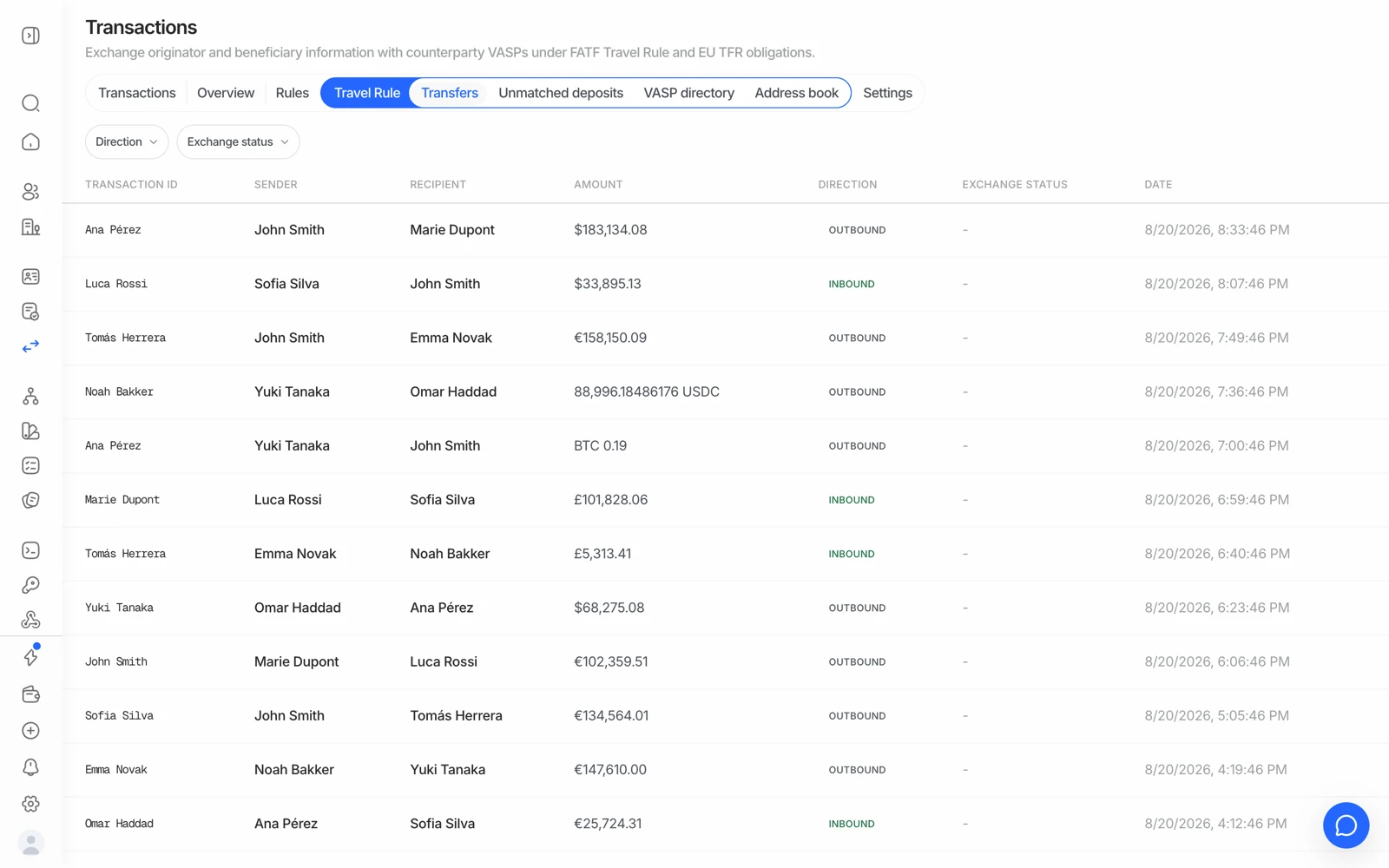
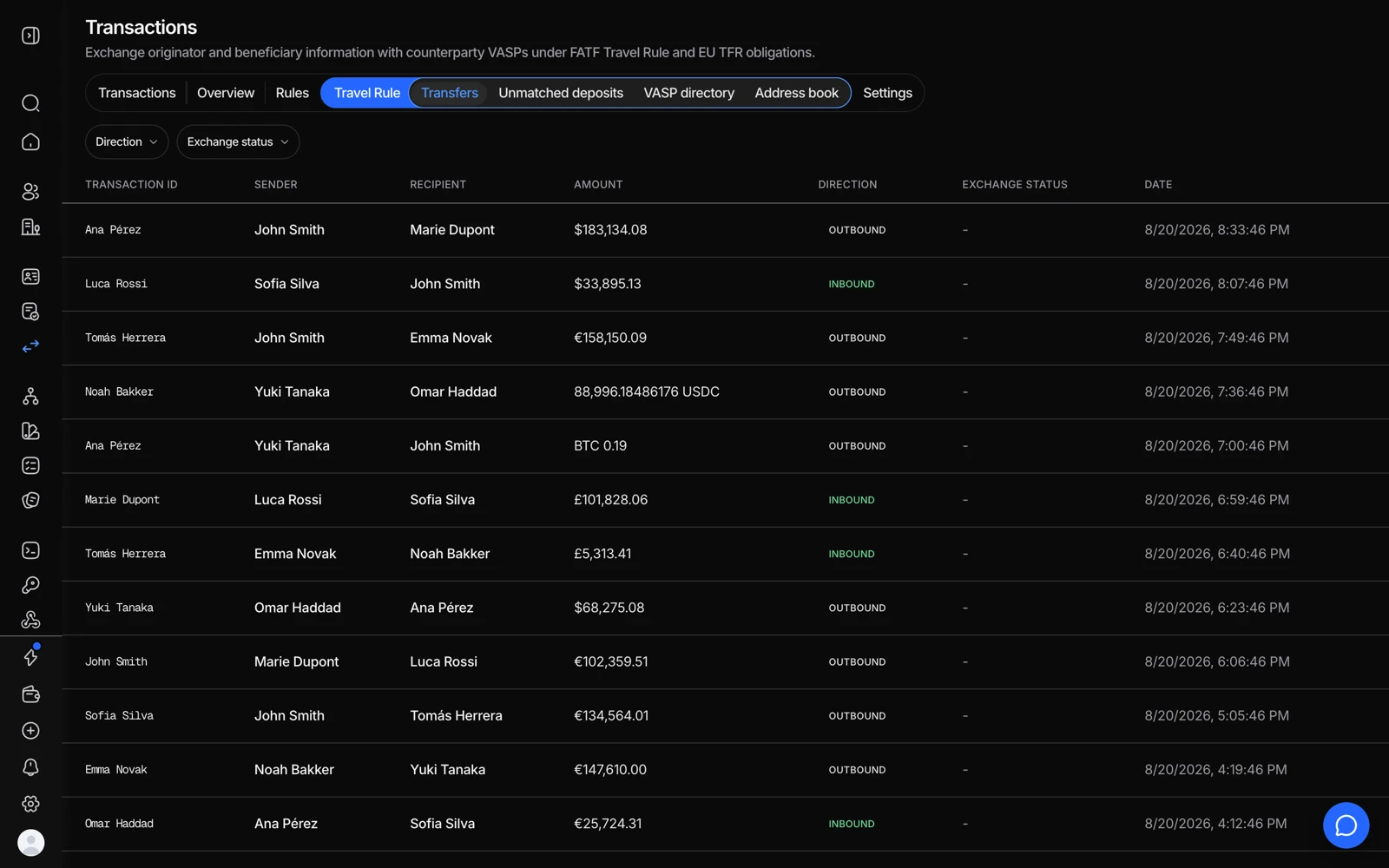
- Transfers is the record of what was sent, to whom, with which counterparty data.
- Unmatched deposits is the queue that needs human attention.
- The VASP directory is how a counterparty exchange is identified.
- Known counterparty addresses live here so repeat transfers resolve automatically.
#Self-custody wallets
A transfer to an address a person controls themselves has no counterparty institution, so there's nothing to exchange information with. What's usually required instead is evidence that your customer controls the address. Didit provides a wallet-ownership flow for this, including a widget you can put in front of your own users.
#Statuses and webhooks
A Travel Rule exchange has its own status, distinct from the transaction's. The travel_rule.status.updated webhook fires on creation, on ownership confirmation, on a counterparty response, on completion or cancellation, and on timeout expiry - for both the outbound transfer and any inbound counterpart.
Build for the timeout case specifically. A counterparty that never responds is a normal outcome, and your process needs a decision for it rather than an exchange that sits open forever.
#What it costs
$0.02 per outbound transfer. Two billing details that matter:
- A Travel Rule transfer is billed on its own $0.02 line instead of the standard transaction screening fee - never both.
- When routing needs a blockchain-analytics wallet lookup to identify the counterparty institution, that lookup is billed once at the wallet verification & screening rate. It is not double-charged if crypto monitoring already screened the same address on the same transaction.
Travel Rule is not in the free tier. See pricing for the full breakdown.
#Scope is a legal question
Which transfers the obligation applies to, above what threshold, and in which jurisdictions, is a compliance determination for your team - it depends on your licences, your markets, and your regulator's implementation of the FATF standard. The platform implements the exchange; it doesn't decide your scope.
If you need confirmation about a specific network, a specific jurisdiction's implementation, or a filing format, get it from your Didit contact in writing. Designing a Travel Rule process around an inference is exactly the kind of thing that surfaces during a supervisory review.