
Registry coverage and ownership data
KYB depth varies by country because registries differ - some publish full ownership, others only officers. Here's how to check what's available for a jurisdiction and what happens when the data isn't there.
Coverage varies per country and per data point, because it depends on what the
local registry publishes. Empty officers or owners with
KYB_OFFICERS_DATA_NOT_FOUND / KYB_OWNERSHIP_DATA_NOT_FOUND usually means the
registry doesn't expose it - not that the lookup failed. In those jurisdictions
the data comes from the business itself or from documents.
#Coverage is per data point, not per country
A country isn't simply "supported" or not. For each jurisdiction, the registry may expose some of these and not others:
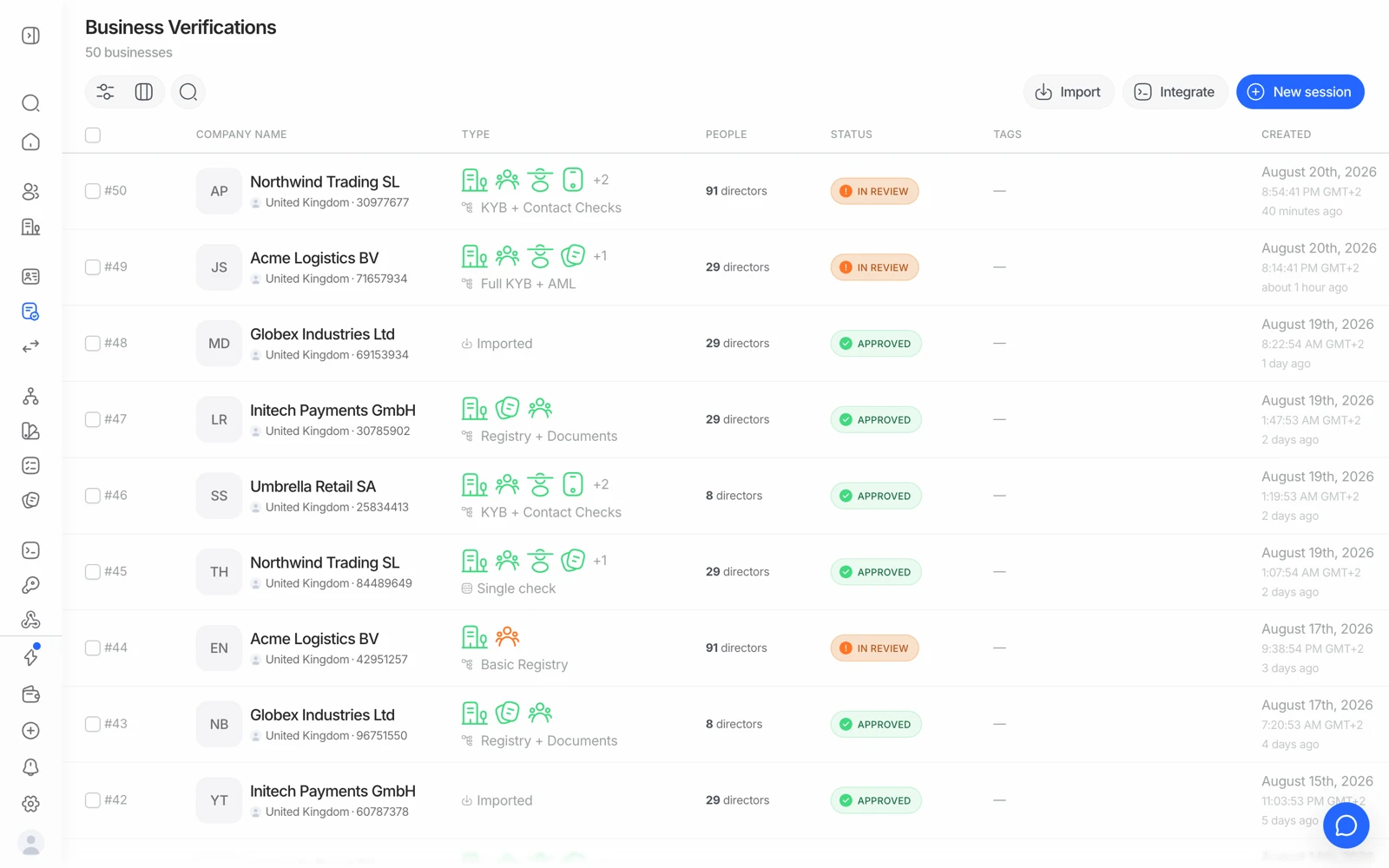
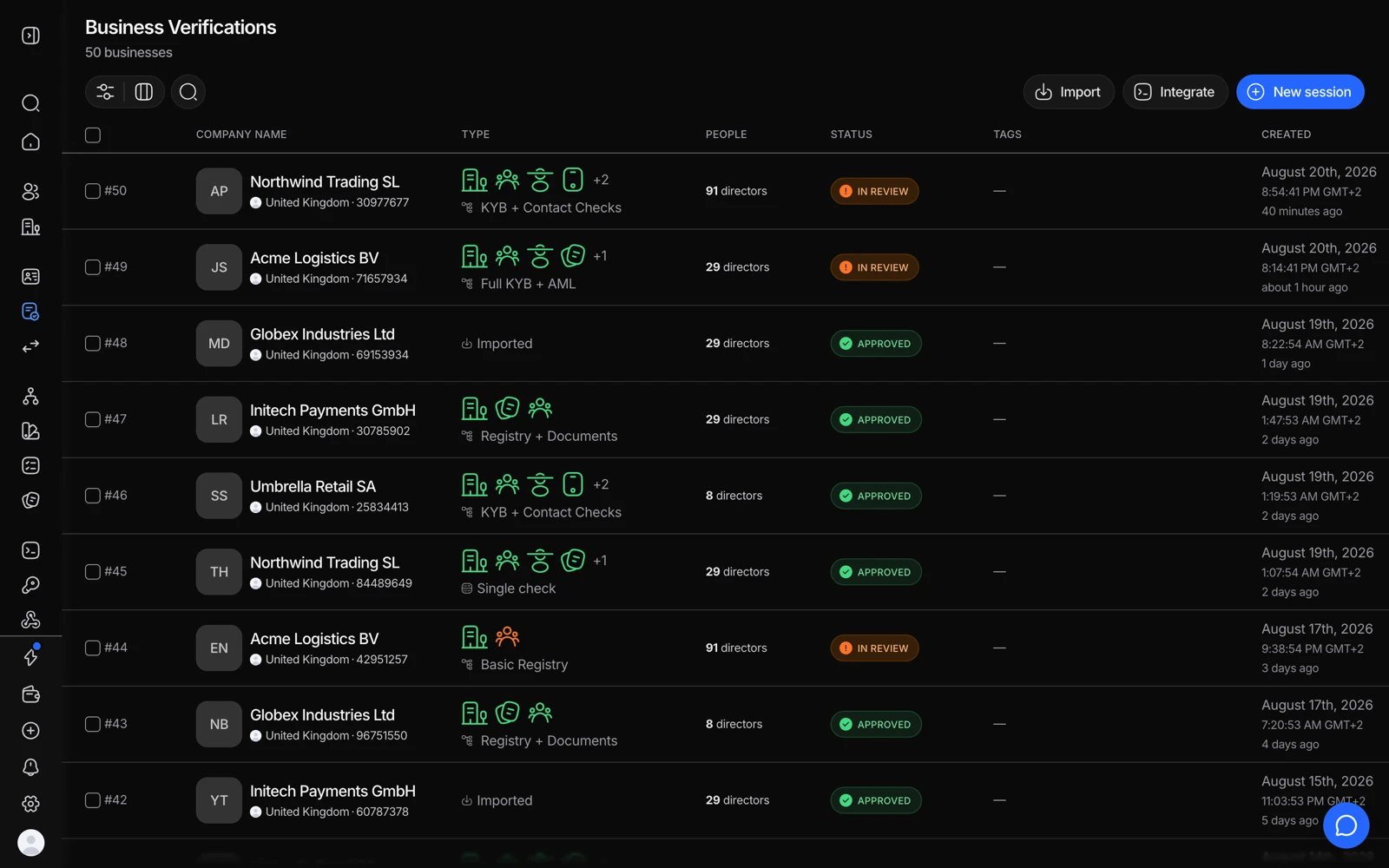
- The legal name as the registry holds it, not as it was typed.
- Type shows the route: a registry lookup, documents, or both.
- Ownership arrives as parties, which is what the People column counts.
| Data point | What it covers |
|---|---|
| Company | Legal name, registration number, incorporation date, status, registered address |
| Officers | Directors, secretaries, and other registered officers |
| Shareholders | Direct shareholders, corporate and individual |
| UBOs | Ultimate beneficial owners above your configured threshold |
| Documents | Source documents available for collection - certificates, articles |
| Financials | Filed annual accounts, summaries, and filing dates |
The supported countries table shows exactly which of these is available per jurisdiction. Where a cell is empty, the registry doesn't publish it and Didit falls back to user-submitted data or document-based verification.
US companies are registered at state level, so the country code uses an extended
US_ form - US_CA, US_NY, US_DE - to select the right Secretary of State
registry. Passing plain US won't resolve to a state registry.
#Empty officers or owners is usually coverage, not an error
If a registry select returns clean company details but empty officers and beneficial_owners alongside KYB_OFFICERS_DATA_NOT_FOUND and KYB_OWNERSHIP_DATA_NOT_FOUND, the lookup worked. That jurisdiction's registry simply does not expose those data points at the tier the lookup reads.
That's a real limitation of public registries, not a Didit configuration you can toggle on. Several major jurisdictions publish company records openly while keeping directors and shareholders behind a paid or restricted extract.
What to do instead:
- Collect it in the hosted flow. The business admin confirms and extends the ownership structure themselves, which is the designed path for exactly these jurisdictions. See verifying the people behind a business.
- Require a document. A shareholder register or certified structure chart, collected as part of the workflow.
- Ask about the specific jurisdiction. If you need officer or shareholder data from a registry that offers it only through a paid extract, raise it with your Didit contact - whether that's available and what it costs is a per-jurisdiction commercial question, not something to infer.
#When a specific company doesn't resolve
Sometimes the country is well covered but one company still comes back thin or unmatched. Usual causes:
- The wrong identifier. A trading name instead of the registered legal name, or a tax number instead of a registration number.
- A recent change. A newly incorporated company, or one that just changed name or address, may not be in the registry snapshot yet.
- A group structure. The entity you're looking for is a branch or a holding company with a different registration number.
- A genuinely registered company reading as unmatched. If the details are right and it still doesn't resolve, that's worth reporting with the company number rather than working around - registry edge cases get fixed.
Don't leave a genuinely registered company sitting In Review indefinitely because the registry lookup was thin. Resolve it deliberately - against a supplied registry reference, a collected document, or a manual review decision with a note. An unresolved review is a decision you've deferred, not avoided.
#Ownership thresholds are yours to set
Who counts as a UBO is a policy choice - the ownership percentage above which a person must be identified and verified. Set it to match your own obligations rather than accepting a default, because it directly determines how many people your KYB flow will ask to verify, and therefore what each business costs you.
#Sandbox and registry data
A sandbox KYB session uses mocked registry responses. It's the right way to test your flow's structure, statuses, and rules, but it tells you nothing about whether a specific real company resolves. For that you need a live session. See testing in sandbox.